Mud Dauber Wasp Nest: Secrets Inside the Dirt Fortress
Mud Dauber Wasp Nest: The Dirt Fortress Built on Spider Corpses
We’ve all seen them—those small, tube-like structures made of hardened clay tucked away in room corners, ceiling edges, or window frames. A typical mud dauber wasp nest appears completely harmless and inert from the outside. However, behind these crude earthen walls lies one of nature’s most sophisticated and chilling survival strategies.
1. Master Architects of the Insect World
Female Mud Dauber Wasps (Sceliphron and Trypoxylon species) are solitary builders. They collect wet clay from muddy banks, carry it back in tiny balls, and carefully shape it layer-by-layer into smooth, compartmentalized chambers. Once the clay structure is complete, a true horror-movie plot unfolds inside.
2. A Living Graveyard Inside the Mud Dauber Wasp Nest
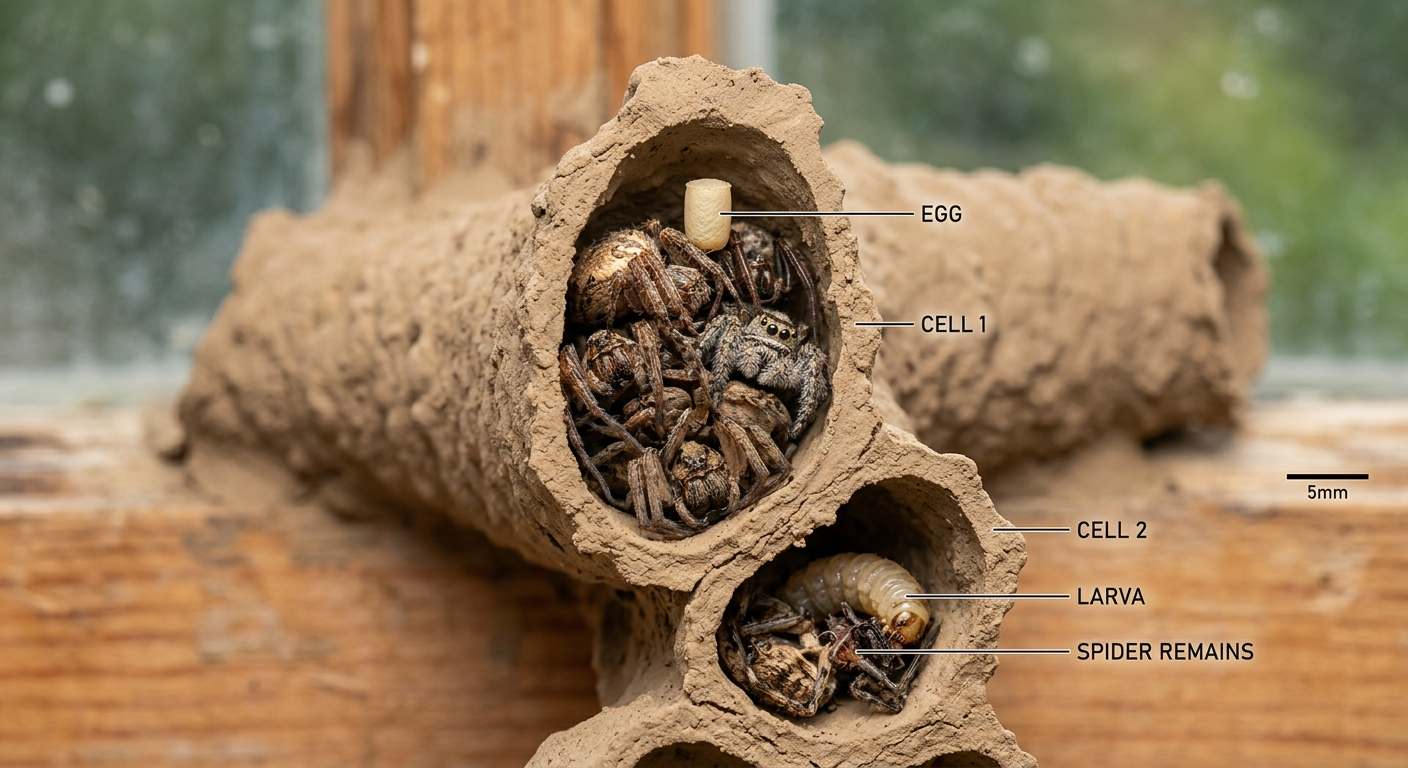
If you were to break open one of these tubes, you wouldn’t find dirt inside—you would find dozens of paralyzed spiders stacked on top of each other.
Mud daubers hunt spiders, including orb-weavers, jumping spiders, and even black widows. Instead of killing them, the wasp stings the spider directly into its nerve centers with surgical precision. This delivers a toxin that causes permanent paralysis without killing the prey.
| Stage | Process & Mechanism |
| 1. Hunted & Paralyzed | The wasp stings the spider, paralyzing its nervous system while keeping its organ functions alive. |
| 2. Encased Alive | The helpless, immobile spiders are dragged into the clay cell and crammed together. |
| 3. Egg Placement | The wasp lays a single egg directly on top of the stack of live spiders. |
| 4. Sealed Entrance | The wasp caps the chamber with a thick plug of mud and flies away, leaving the prey trapped in darkness. |
3. Fresh Meat for the Larva
When the egg hatches into a larva inside the chamber, it finds itself surrounded by a feast of fresh, living meat. The larva eats the paralyzed spiders one by one while they are still conscious and breathing.
Why paralyze instead of kill? Dead spiders decompose rapidly in warm, humid clay chambers. By keeping the spiders alive, the wasp creates a natural refrigeration system, ensuring its larva gets fresh, unspoiled nutrition for weeks.
Once the larva consumes the entire cache, it spins a cocoon, pupates, and eventually chews its way out through the hardened wall as a fully grown adult wasp.
Are These Clay Structures Dangerous to Humans?
Despite their terrifying hunting methods, mud dauber wasps are non-aggressive toward humans. Unlike social wasps or hornets, they do not defend their homes aggressively and rarely sting unless explicitly stepped on or handled. In fact, they act as effective pest controllers by keeping indoor and outdoor spider populations in check.
The next time you spot a mud dauber wasp nest in a window frame, remember: you are looking at an airtight, macabre fortress of living prey designed for the next generation to survive.